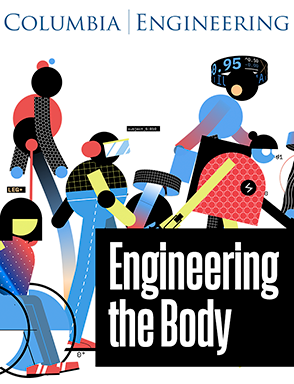
FEATURED STORY |  MAKING AN IMPACT ON HEALTH

Columbia Engineering has had a significant impact on bettering the human condition since its founding in 1864. As you will see in the following pages, the scope of health-related research at Columbia Engineering involves almost every department. Amazing breakthroughs have happened or are about to happen as our faculty fight diseases and conditions, bringing to bear their exceptional and unique talents to chip away at problems that affect the quality of life and, indeed, life itself.

See the print version (pdf)


UNLOCKING THE BRAIN'S SECRETS

Walk into any clinical research lab and you will undoubtedly find one or more microscopes. The problem with conventional microscopes, however, is they can only show images of thin slices of dead tissue or cells in a dish. It takes a special kind of instrument to produce images from inside the living body, which is exactly the kind that Elizabeth Hillman is building.

THE BIOLOGY OF PSYCHIATRIC DISORDERS

Little is known about the biological causes for psychiatric disorders like schizophrenia and bipolar, which combined afflict an estimated 10 million people nationwide. Columbia researchers are working hard to change that by exploring the role of genetics from a multidisciplinary approach.

REPAIRING TORN LIGAMENTS

With the rate of ACL tears and other soft tissue injuries increasing in all segments of the population, it is a hopeful sign that Professor Helen H. Lu has developed a new approach to help the body heal after these debilitating soft tissue injuries.

CAPTURING THE "AHA!" MOMENT

It is very difficult to ask a computer to find something that is funny to a particular person on the Internet. It is even more difficult to build a computerized vision system that can find something that is funny or suspicious or interesting—and find its way around a room.

FIXING BROKEN HEARTS AND BONES

In 2009, an estimated 785,000 Americans will have a new coronary attack, and about 470,000 will have a recurrent attack, while more than 35 million Americans suffer from TMJ — temporomandibular joint disorders. What is the connection? The work of Professor Gordana Vunjak-Novakovic of the Department of Biomedical Engineering, who is building complex human tissues that may help resolve both these debilitating conditions.